 blackseed
blackseed
blackseed
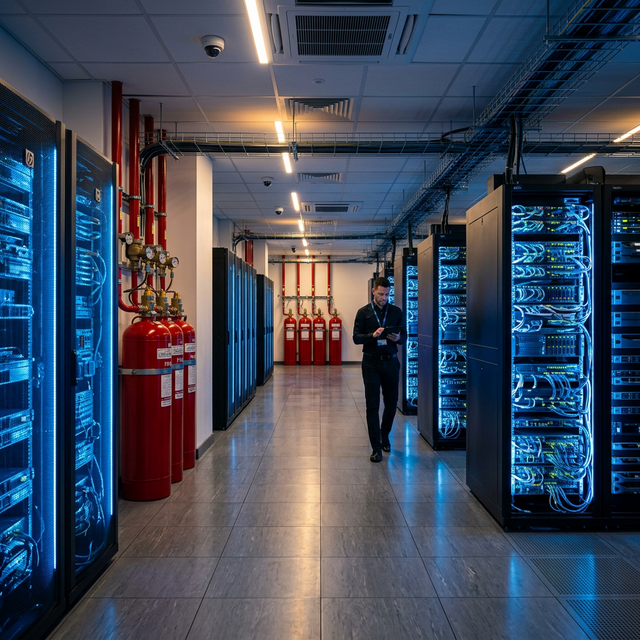
Data is the lifeblood of your business. But what happens when the very system designed to protect it from fire ends up destroying your servers with water or corrosive powder?
Server rooms generate massive amounts of heat and are highly susceptible to electrical fires. Using traditional water sprinklers or powder systems can cause catastrophic collateral damage to delicate hard drives and server racks, leading to massive data loss and extended downtime. This is where clean agents like FK-5-1-12 (the standard chemical equivalent to Novec 1230) become essential for modern IT infrastructure.
FK-5-1-12 is an environmentally friendly clean agent that rapidly extinguishes fires by removing heat, rather than displacing oxygen. According to NFPA 2001 standards, clean agents are the preferred method for protecting Class A and Class C (electrical) hazards inherently found in server rooms. Upon discharge, FK-5-1-12 uniformly floods the space and leaves absolutely no residue, ensuring your servers remain completely unharmed and your operations can resume immediately after the threat is neutralized.
Don't let a minor fire lead to major data loss. Ensure your server room meets strict NFPA 2001 standards with a custom FK-5-1-12 system.
Contact Us for a Free Site SurveyIt is a clean agent fire suppression gas, functionally equivalent to Novec 1230, that extinguishes fires rapidly without leaving harmful residue.
No. Unlike water or foam, FK-5-1-12 is electrically non-conductive and residue-free, making it completely safe for sensitive server infrastructure.
Designed directly against NFPA 2001 standards, the system detects and suppresses fires typically within an industry-leading 10 seconds of discharge.